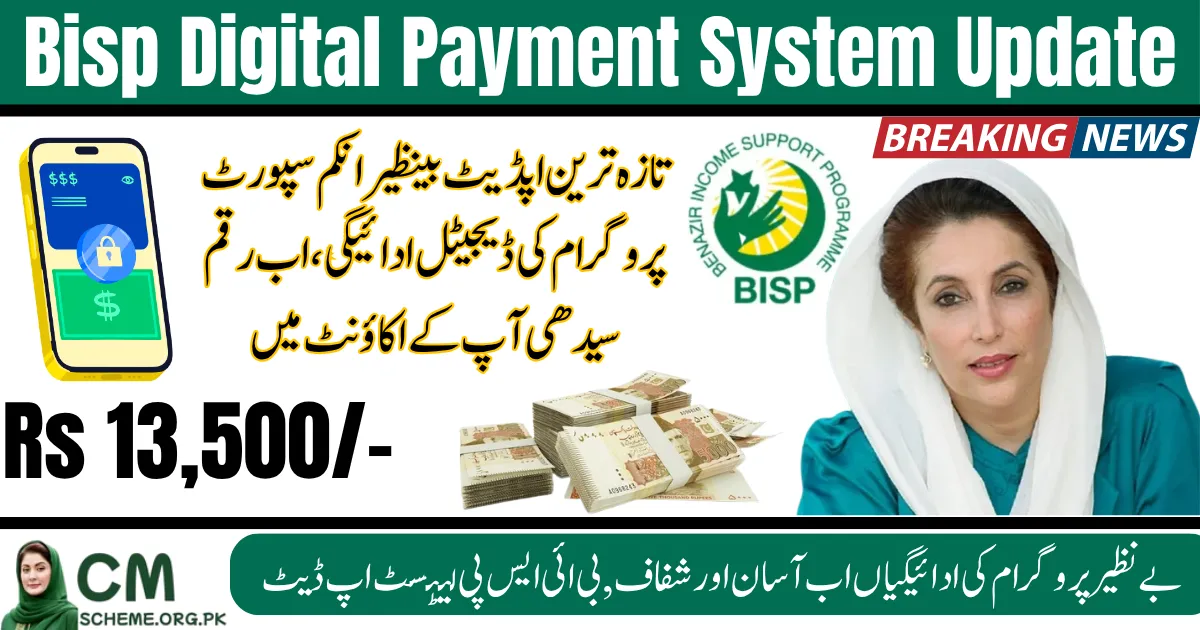
BISP Digital Payment System Update — Get Your Money Directly In Your Digital Accounts
What if you could receive your Benazir Income Support Programme (BISP) payment straight into your bank account or mobile wallet—without waiting in long lines, facing heat, or dealing with middlemen? That’s exactly what the new BISP digital payment system update is bringing for millions of families across Pakistan. This upgrade is more than just a change in the way money is distributed; it’s a step toward dignity, convenience, and financial empowerment.
Starting in 2025, BISP beneficiaries are being shifted to a secure and transparent system where payments arrive directly in their accounts.No more hidden deductions, no more wasted hours, and no more uncertainty. Whether you live in a big city or a remote village, this update promises to make access to your rightful support easier than ever before. Curious to know how it works, who qualifies, and when you can expect it in your area? Let’s dive in.
Also Read: BISP Reverification October 2025–A Golden Chance For In eligible Beneficiaries
Below is a quick overview before we dive in:
| Item | Info / Status |
|---|---|
| Program | BISP (Benazir Income Support Programme) |
| Current beneficiary count | ~9 million families under “Benazir Kafaalat” |
| New mechanism | Digital wallets / bank accounts / mobile accounts |
| Launch date (pilot / rollout) | Starting August 13, 2025 in major cities |
| Target wallets to issue | 10 million digital wallets |
| Supporting system | Raast instant payment infrastructure by SBP |
Why This Update Matters
Let me tell you a story. A beneficiary in a remote village once traveled miles in scorching heat to reach a BISP camp, only to learn that her fingerprint had a mismatch or the camp had closed early. She returned home empty-handed that day. That scenario is becoming an undesirable memory. Pakistan’s BISP is now aggressively pursuing a digital payment system update so that beneficiaries—especially women heads of households—can get funds directly into an account or wallet, from anywhere, in a seamless, dignified way. This transformation is not theoretical. The government has already launched 10 million digital wallets, tied them to biometric verification, freed up SIM distribution for connectivity, and is piloting this in key districts.
Imagine waking up one morning and finding Rs. 13,500 (or your entitled stipend) deposited in your mobile wallet or bank account without standing in long queues or visiting campsites. That’s the promise behind the BISP digital payment system update, a transformation underway in Pakistan’s flagship social welfare program. The Benazir Income Support Programme (BISP) is shifting from conventional cash disbursement to a modern, secure, efficient “cashless economy” model. This article unpacks how the new system works, who qualifies, when and where it will be rolled out, and how you (or someone you care about) can receive this benefit in your account — all based on the latest data from BISP, State Bank of Pakistan, and other official sources.
This update promises financial inclusion, reduction of corruption or “retail mafia,” and transparency at all levels. So if you or someone you know is an eligible BISP beneficiary, this update could change how and when you receive your payments — right into your account, with dignity and ease.
Also Read: BISP 8171 Tracking Portal October 2025 – Check Payments & Eligibility Online
What Is BISP & Who Qualifies?
What is BISP?
BISP (Benazir Income Support Programme) is Pakistan’s premier social safety net scheme. Its flagship component—Benazir Kafaalat—delivers unconditional cash transfers to the poorest households, prioritizing women heads. It began in 2008 and gradually expanded. Today, around 9 million families benefit from it.
The stipend amount has evolved: once Rs. 3,000 per quarter, currently it’s structured around Rs. 8,500 per quarter per beneficiary under Kafaalat. For families with differently-abled persons, the eligibility threshold is more generous.
Other BISP programmes include Benazir Taleemi Wazaif, giving stipends to enrolled children (girls receive higher amounts) with attendance requirements. As of recent data, over 12 million children are enrolled across education levels.
Eligibility Criteria
To be eligible under BISP Kafaalat, the following are typically required:
- Household must be in the National Socio-Economic Registry (NSER).
- Proxy Means Test (PMT) score below cut-off (currently 32, though relaxed to 37 for special cases)
- The applicant is female head of household or in vulnerable groups.
- CNIC must be valid and information up to date.
- Household must not have disqualifying assets (land, business) beyond the allowed threshold.
- Because BISP evolves, these criteria may be updated.
- Always check the official BISP website.
Also Read: Ehsaas Kafalat Payment 2025 CNIC Check—Complete Guide for Families
The Digital Payment System Update: What Is Changing?
Why the Change?
Traditional disbursements have faced issues: corrupt commissions by intermediaries, biometric mismatch problems, logistical delays, and exposure to heat or long lines. Former schemes relied on campsites or local agents. Many beneficiaries complained about “retail mafia” extracting unauthorized fees. By using bank accounts, digital wallets, and secure infrastructure, the government aims to remove these pain points.
What the Update Entails
Digital Wallets / Mobile Accounts
The government will issue 10 million digital wallets for BISP beneficiaries, tied to CNIC and biometric verification. These wallets may be realized via JazzCash, EasyPaisa, or partner bank mobile accounts depending on region.
Opening Bank Accounts (Sahulat Accounts / RAAST integration)
In a parallel track, BISP will open “Sahulat Accounts” for beneficiaries. Via SMS or web portal, beneficiaries will be informed which bank branch and when to activate their account. This model uses the Raast instant payment system (built by SBP) to settle transfers in real time.
Pilot Launch & Phased Rollout
The pilot phase started on August 13, 2025, in major cities (Karachi, Lahore, Quetta, Gilgit, Muzaffarabad, Peshawar) where accounts are being opened for women beneficiaries. In several districts, BISP is accelerating this via RAAST in 7 districts.
Retail Payment Model
Starting June 16, 2025, BISP began a retail-based payment model, where beneficiaries can go to authorized retail outlets (with CNIC verification) instead of traditional camps. This was partly in response to heatwave risks. This model is a bridge between full digital rollout and older methods.
Transparency & Service Info via SMS / Web Portal
Beneficiaries can receive SMS or log into web portals to see which bank branch their account is open, activation schedule, etc.
Also Read: Complete CM Punjab E Taxi Scheme Online Registration 2025 Guide
How to Get the Payment in Your Account (Step-by-Step)
1. Verify Your Status / Eligibility
Use the BISP 8171 service: send your 13-digit CNIC to 8171 via SMS (without dashes) or enter it at the 8171 BISP web portal to check eligibility and payment status.This service is free.You may see statuses like “Payment Ready,” “Under Verification,” “Eligible,” or “Not Eligible.”
2. Account / Wallet Opening
If you are selected in the pilot or rollout phase, you’ll receive notice (via SMS/web) about which bank your account is opened in, branch address, and dates for activation. Go to that branch with your CNIC and any documents needed to activate the account.
Alternatively, if a digital wallet is assigned, it may already be pre-created based on area and partner platforms (JazzCash, EasyPaisa, or bank’s mobile wallet) for you to start using.
3. Payment Disbursement
Once your account or wallet is active, future stipend payments will be directly transferred via digital means (using Raast or wallet infrastructure) into your account or wallet — no need for camps or queues.
Where rollout is not yet complete, payments may still go via camps, banks, or retail outlets as interim mechanisms (retail model).
You can withdraw from ATMs or via wallet-enabled agents per usual.

When and Where Is the Rollout Happening?
- Pilot launch began August 13, 2025 in major cities including Karachi, Lahore, Quetta, Gilgit, Muzaffarabad, and Peshawar.
- In seven districts, BISP is fast-tracking new digital payment via Raast for early implementation.
- Retail payment model launched June 16, 2025, as an interim method across the country.
- The 10 million wallet issuance is being distributed broadly across districts; SIM cards are also being provided free in some areas for connectivity.
- Some regions still use camps or local agents until full digital coverage is achieved.
Because the scheme is phased, some areas may receive full digital payments earlier than others. Always check local BISP announcements or SMS messages.
What About Security, Fraud, and Challenges?
Moving to digital payments also means new challenges:
- Biometric mismatches or technical errors may block payments; beneficiaries must ensure their CNIC/fingerprint data is up-to-date.
- Connectivity issues in rural areas could hamper activation of accounts or wallets — that’s why free SIM distribution is targeted.
- Data privacy and leaks are a concern. There have been recent reports of sensitive personal data exposure in Pakistan.
- Resistance or inertia in areas used to traditional cash distribution.
- Implementation delays in rollout across remote districts.
To mitigate, BISP is piloting first, giving advance notice via SMS, building transparency, and using robust systems like Raast for secure infrastructure.
Also Read: CM Punjab e Taxi Scheme Online Apply 2025 – Eligibility, Benefits & Updates
Real-Life Example (Hypothetical but Plausible)
A woman in Rahim Yar Khan was previously forced to travel 15 km to the nearest camp. In a recent pilot, she received an SMS that her BISP account has been opened at the district branch. She went there, gave her CNIC and biometric data, and her account was activated in under an hour. When the next quarterly stipend came, she simply saw it in her mobile wallet (JazzCash) and withdrew cash from a nearby agent — no travel, no queue, no middlemen. That matches what BISP expects for millions of beneficiaries under this update.
Why “BISP Digital Payment System Update” Matters
- Empowerment & dignity: women get access without stigma or intermediaries.
- Eliminate corruption: less scope for “retail mafia” skimming money.
- Transparency & auditability: every transaction leaves a digital trail.
- Speed & efficiency: real-time transfers via Raast or wallets.
- Financial inclusion: beneficiaries become part of the formal banking/mobile finance ecosystem.
Frequently Asked Questions (FAQs)
1. How can I check if I am eligible for the BISP digital payment system update?
You can check eligibility by sending your CNIC number to 8171 through SMS or by visiting the official 8171 web portal. The system will quickly confirm if you’re eligible, registered, or under verification. It’s completely free and works on all mobile networks across Pakistan, making it simple for beneficiaries.
2. When will I start receiving BISP payments directly in my account?
The digital payment system started in major cities from August 2025 and will gradually reach all districts. If your account is opened, you’ll get an SMS with details. Until it’s launched in your area, payments will continue through banks, retail shops, or camps. Always check your SMS alerts from 8171.
3. What if I don’t have a mobile wallet or bank account for BISP payments?
No need to worry. BISP itself is creating digital wallets and Sahulat accounts for beneficiaries. You’ll be notified by SMS about the bank branch or mobile service where your account is opened. If your area is not yet covered, you can still collect payments from the usual retail outlets or camps.
4. How do I withdraw money once I get it in my digital account?
With digital accounts, you can withdraw your BISP payment from ATMs, bank branches, or mobile wallet agents like EasyPaisa and JazzCash. Simply show your CNIC for verification. Mobile wallets also let you keep some balance for buying goods or paying bills directly, making the process both safe and convenient.
5. What should I do if my biometric verification fails?
If biometric verification fails, first clean your hands and try again. If it still doesn’t work, visit the nearest NADRA office to update your fingerprints and CNIC records. You can also contact the BISP helpline or a local BISP office, where they provide solutions to process payments without extra delays.
Also Read: Himat Card Program 2025: Complete Guide for PWDs in Punjab – Benefits, Eligibility & How to Apply
Conclusion
The BISP digital payment system update is a big step toward making life easier for millions of deserving families in Pakistan. Instead of wasting time in long lines or worrying about unfair deductions, beneficiaries can now receive their money directly into bank accounts or mobile wallets. This change gives people more control, safety, and dignity when accessing their support. With the help of digital wallets, Sahulat accounts, and the Raast system, payments are becoming faster, more transparent, and less stressful.
Of course, some challenges like biometric mismatches or poor connectivity still exist, but the government is working to fix them step by step. For families who rely on BISP, this new system means hope for a smoother and fairer future. If you’re eligible, make sure your CNIC and records are updated so you can start receiving your payments directly and enjoy the ease of this new digital system.