PMT Score Important in BISP—How It Unlocks BISP & Punjab Welfare Benefits
What if a single number PMT Score Important in BISP could determine whether your family receives crucial financial support or not? In Pakistan, that number is your PMT Score. This score, ranging from 0 to 100, assesses your household’s poverty level based on factors like income, assets, and family size. In 2025, understanding your PMT Score is more important than ever, as it directly influences eligibility for programs like the Benazir Income Support Programme (BISP) and various Punjab government schemes.
For instance, to qualify for BISP’s Benazir Kafaalat program, your PMT Score must be 32 or below. Similarly, Punjab’s Apni Chhat Apna Ghar scheme sets a threshold of 60 for eligibility.But what if your circumstances have changed? Fortunately, the government allows for Dynamic Surveys, enabling you to update your information and potentially lower your PMT Score to qualify for assistance.
In this guide, we’ll walk you through everything you need to know about the PMT Score, its significance, and how to check and update it to ensure your family gets the support it deserves.
Also Read: Secure Your Rs. 13,500 – BISP 8171 October 2025 Re-verification Explained
PMT Score & Its Role in 2025
| Item | Detail |
|---|---|
| Full form | Proxy Means Test (PMT) |
| Score range | 0 to 100 (lower = poorer) |
| BISP cut-off | ≤ 32 (or ≤ 37 for differently-abled) |
| Punjab schemes using PMT | Eg. ACAG (Apni Chat Apna Ghar) uses threshold ~60 for Punjab context |
| Disbursement channels | Bank accounts, biometric payment centers (HBL, Bank Alfalah) |
| Re-survey / appeal | Via BISP / NSER dynamic survey if condition changes |
What Is the PMT Score and Why Does It Matter?
The PMT Score, or Proxy Means Test, is a statistical mechanism the government uses to assess household welfare. It takes into account income, assets, family size, education, housing quality, utility access, and more. The logic is straightforward: households with lower scores are considered poorer and more deserving of support. This helps governments allocate limited funds to the most needy.
In practice, the PMT makes the difference between being eligible for BISP or provincial aid schemes and being excluded even if you are financially struggling. Because budgets are always constrained, having an objective measure helps reduce abuse, favoritism, and ensures transparency.
Also Read: Benazir Taleemi Wazaif October 2025: Your Complete Guide to Payments & Registration
PMT Score Important in BISP: How It Works and Its Importance
How BISP Uses PMT to Choose Beneficiaries
BISP uses the PMT via data collected through the National Socio-Economic Registry (NSER). Enumerators survey households with around 60+ questions about assets, families, education, employment, and housing. Responses are scored and a composite PMT number is produced.
Once scores are computed, the BISP Board sets a cut-off, currently 32 (or 37 for households with differently-abled members) for eligibility under the Benazir Kafaalat programme.
If your score is ≤ 32, you are eligible to receive unconditional cash transfers every quarter (e.g. Rs. 13,500 in recent years).
Why the PMT Score Is Important in BISP
The PMT Score Important in BISP because:
- It keeps the program fiscally sustainable by limiting support to those who are truly needy.
- It promotes accountability and fairness—help isn’t given on connections but on empirically measured need.
- It allows dynamic re-assessment: if your situation worsens (e.g. job loss, death, illness), you can request a re-survey to lower your score and regain eligibility.
- It integrates with other programs: BISP sometimes uses PMT data to connect deserving households with education stipends, health support, or emergency cash.
Also Read: BISP CNIC Expiry Payment Issue 2025—How to Fix It and Secure Your Payments
PMT in Punjab Schemes: How Provincial Programs Use It
Punjab government schemes often adopt or reference the PMT as a tool to target subsidies or housing programs. For instance, the ACAG (Apni Chat Apna Ghar) program in Punjab reportedly accepts those with a PMT score ≤ 60 in its context.
Because provincial funds are smaller than federal ones, reliance on PMT ensures aid is better targeted. However, thresholds in Punjab may be more flexible; local policy, area poverty levels, and project objectives influence where the cut-offs lie. Thus, PMT Score Important in BISP also extends to being a benchmark for provincial eligibility, ensuring consistency in social protection.
One challenge: PMT data collected under a federal survey may not always match local conditions—housing cost differences, inflation, or regional asset value fluctuations may skew how well PMT predicts suffering in different districts.
When Is PMT Used and What Latest Updates Are There?
Timeline & Application in 2025
PMT is used at registration time when households apply to BISP or provincial schemes. Once surveyed, the score is used until a cut-off is reset or until a dynamic survey happens. In 2025, significant changes include:
- The HSPS (Hybrid Social Protection Scheme) pilot launched in December 2023 integrates households with PMT up to 40, expanding coverage beyond the strict cut-off of 32.
- Cut-offs and thresholds are under review regularly as inflation soars and poverty lines shift.
- BISP continues dynamic surveys so families whose income declines can reenter eligibility.
Also Read: Go Green: E Bike Registration Online 2025 Guide
Real-Life Example
Consider a family whose breadwinner lost a job in 2024. In 2022 their PMT was 35 (too high). When they request a survey after losing income, new data lowers the PMT to 28. They now become eligible and begin receiving quarterly aid of Rs. 13,500 in 2025. Without the PMT mechanism, such changes might go unrecognized.
Freequently Asked Questions (FAQs)
1. What is the PMT Score in BISP?
The PMT (Poverty Means Test) Score is a numerical value assigned to households based on their socio-economic status. It determines eligibility for financial assistance under programs like BISP and various Punjab schemes. A lower score indicates higher poverty levels and greater need for support.
2. How can I check my PMT Score?
You can check your PMT Score through three methods:
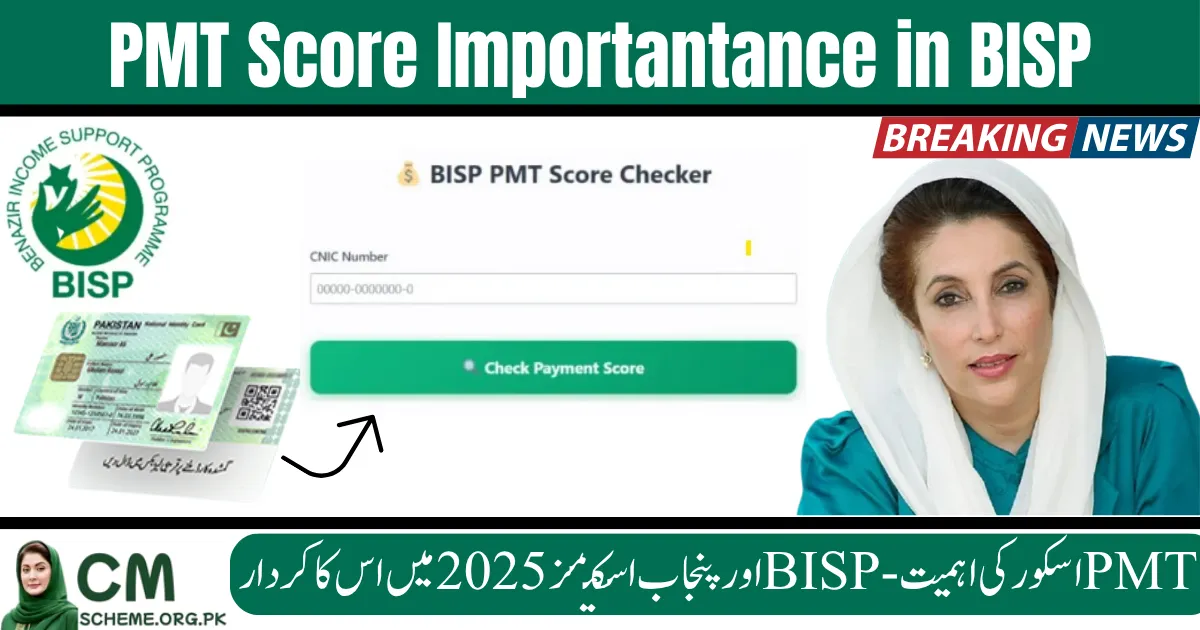
Online Portal: Enter your 13-digit CNIC, complete the CAPTCHA, and submit.
SMS Service: Send your CNIC (without dashes) to 8171. You’ll receive your PMT Score and eligibility status via SMS.
Tehsil Office: Visit your nearest BISP Tehsil Office with your CNIC. Officials will provide your PMT Score and eligibility information.
3. What PMT Score is required for BISP eligibility?
To qualify for BISP’s Benazir Kafaalat program, your household’s PMT Score must be 32 or below. For other schemes like the Punjab Minority Card Scheme, the threshold may vary; for instance, a PMT Score of 45 or below is required.
4. Can I update my PMT Score if my circumstances change?
Yes, you can update your PMT Score by participating in a Dynamic Survey. Visit your nearest BISP or NADRA office with the necessary documents to update your household information. After re-verification, you can request an updated PMT Score.
5. How often should I check my PMT Score?
It’s advisable to check your PMT Score regularly, especially after significant life changes such as changes in income, family size, or assets. Regular checks ensure that your eligibility status is up-to-date and reflect any changes in your circumstances.
6. What if my PMT Score is above the eligibility threshold?
If your PMT Score exceeds the eligibility threshold for programs like BISP or Punjab schemes, you may not qualify for assistance. However, you can still update your information through a Dynamic Survey to reflect any changes in your circumstances that might lower your PMT Score.
7. Is there any financial assistance for families with higher PMT Scores?
While programs like BISP primarily target households with lower PMT Scores, other initiatives may offer support to families with higher scores. For example, the Punjab Minority Card Scheme provides Rs. 10,500 every three months to minority families with a PMT Score of 45 or below.
8. Can I apply for multiple schemes simultaneously?
Yes, you can apply for multiple schemes, provided you meet the eligibility criteria for each. However, some programs may have overlapping benefits, and receiving assistance from one may affect eligibility for another. It’s important to check the specific requirements of each scheme before applying.
9. How can I ensure my family remains eligible for assistance?
To maintain eligibility for assistance programs, ensure that your household information is accurate and up-to-date. Participate in Dynamic Surveys, update your details with NADRA, and regularly check your PMT Score to reflect any changes in your circumstances.
10. Where can I get more information about PMT Score and related schemes?
For detailed information about PMT Score and related schemes, visit the official BISP website or the Punjab Government’s official portal,. These sites provide comprehensive information about eligibility, application processes, and updates on various welfare programs.
Also Read: Roll Your Future: CM Punjab Bike Scheme Apply Online Guide
Conclusion
Your PMT Score is more than just a number—it is the key that determines whether your family can access vital financial support in Pakistan. Programs like BISP’s Benazir Kafaalat and Punjab’s welfare schemes rely on this score to ensure that assistance reaches those who need it most. Knowing your PMT Score, checking it regularly, and updating your information through Dynamic Surveys can make a real difference, especially if your household circumstances change.
In 2025, understanding how the PMT Score Important in BISP and provincial programs works can help you navigate the application process, qualify for benefits, and improve your family’s well-being. With accurate information and timely action, you can ensure that you are not left out of support programs designed to help vulnerable households. Staying informed, proactive, and aware of your eligibility is the first step toward securing financial relief and stability.